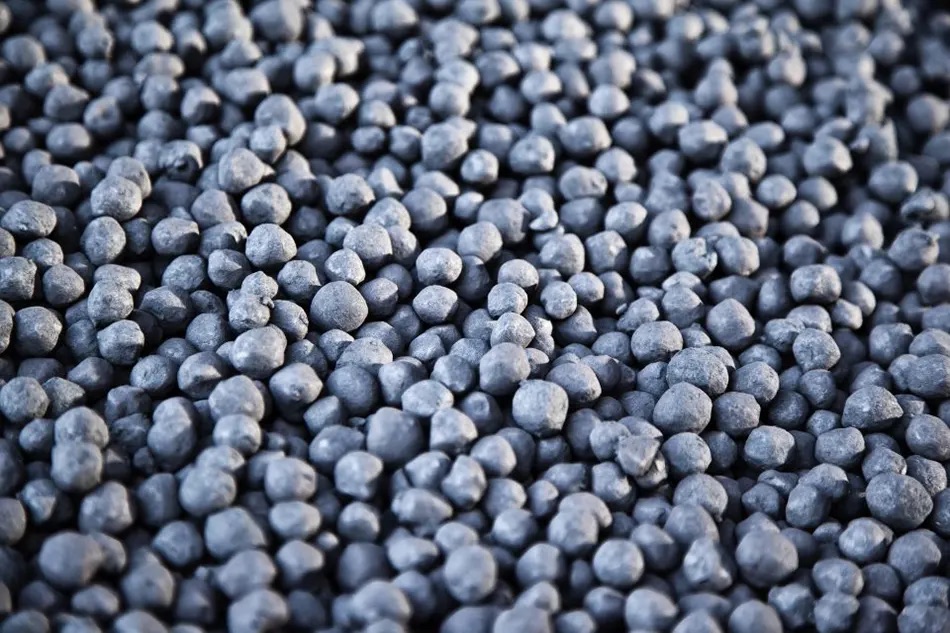
Iron ore pellets are rounded agglomerates made from fine concentrate and selected additives. Moist material is formed into green balls in discs or drums and then hardened by heat. This converts fine feed into a more consistent form for bulk handling and furnace charging.
Pellets are used in blast furnaces and direct-reduction plants, with different chemistry and physical properties selected for each route. Iron content and gangue influence the receiving process, while strength, abrasion and size distribution affect handling and permeability. The tables below set out a chemical and physical reference profile. Confirm the furnace route, moisture and current batch results before selecting material.
Size guide
Sizes & dimensions
Iron ore pellets — Size guide
Parameter
Size or format
Main pellet fraction
9–16 mm
Share within the main fraction
Minimum 90%
Pellet-making concentrate reference
Below 45 μm; feed material, not finished pellet size
Confirm undersize, oversize, moisture and handling requirements in the order.
Technical reference
Analysis
This pellet profile combines the chemical composition with the physical properties important for handling and furnace charging. Confirm the receiving process and the current batch analysis.
Reading the values
≤ Maximum · ≥ Minimum
A dash between two values indicates a range.
Composition profile
Iron ore pellets — chemical analysis
Chemical values are percentages by mass. Alumina and magnesium oxide are stated values without a specified maximum or minimum.
Iron ore pellets — chemical analysis
Parameter
Reference value
Unit
Total iron (Fe)
≥ 65
%
Silica (SiO₂)
≤ 4
%
Calcium oxide (CaO)
≤ 0.7
%
Alumina (Al₂O₃)
0.07
%
Phosphorus (P)
≤ 0.05
%
Sulphur (S)
≤ 0.08
%
Magnesium oxide (MgO)
0.4
%
Composition profile
Pellet size and physical properties
Reference physical characteristics. Size fraction, porosity, tumble index and abrasion index describe different measurements.
Pellet size and physical properties
Parameter
Reference value
Unit
Fraction within 9–16 mm
≥ 90
%
Porosity
19–24
%
Tumble index
≥ 95
%
Abrasion index
≤ 4
%
These tables describe reference composition options. Final chemistry and delivery requirements are confirmed in the quotation and heat-analysis certificate.
02 / Specification guide
Define your requirement.
These are the details to provide, not a fixed offered specification.
Application
Intended use, processing route and required delivery condition.
Chemical composition
Required element ranges and impurity limits.
Dimensions & tolerances
Required dimensions, length or particle sizing and permitted tolerances.
Quality requirements
Relevant mechanical or physical properties and inspection requirements.
Packing & identification
Packing format, bundle or lot identification and handling requirements.
Commercial terms
Quantity, delivery destination and required delivery window.
03 / Documents to request
Make the brief complete.
State which documents and approvals are required. Availability and scope are confirmed for each enquiry.
01
Batch or heat certificate of analysis for the agreed material.
02
Dimensional and relevant physical or mechanical inspection reports.
03
Packing list, lot identification and agreed shipment documents.