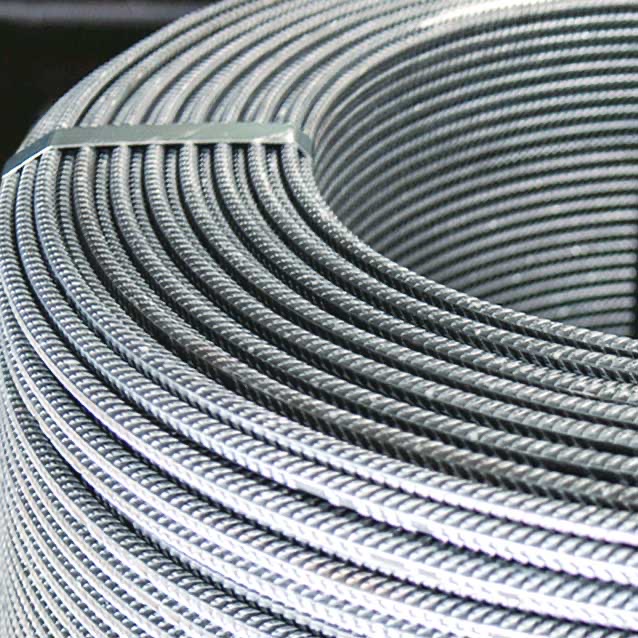
Ribbed rebar coil combines the surface of deformed reinforcing bar with a continuous coiled delivery form. It is intended for reinforcement processing, where the material can be straightened, cut and bent into the required shapes. Coils suit fabricators using automated equipment and can reduce the number of short offcuts associated with fixed straight-bar lengths.
The coil must match the straightening line and lifting equipment as well as the finished reinforcement requirement. Wire diameter, coil dimensions and coil mass are separate ordering details. The processed reinforcement also needs the required mechanical properties and rib geometry after straightening; a coil description alone does not establish those properties.
For quotation, state the required diameter, grade, total quantity and processing application. Include acceptable coil dimensions and mass where the machine or handling system imposes limits. The analysis below provides a weldable reinforcing-grade example. Plain wire rod for drawing and fastener production is listed separately because it has different surface and processing requirements.
Size guide
Sizes & dimensions
Ribbed rebar coils — Size guide
Parameter
Size or format
Reference bar diameter
8, 10, 12, 14, 16 mm
Reference coil inside diameter
850–950 mm
Reference coil mass
1,050–1,200 kg
These are reference market dimensions for discussing an enquiry. Confirm the required combination and availability in the quotation.
Technical reference
Analysis
Chemical composition is selected for the intended manufacturing or construction use. Confirm the agreed grade and heat analysis for the order.
Reading the values
≤ Maximum · ≥ Minimum
A dash between two values indicates a range.
Composition profile
Reinforcing steel — chemical analysis
Reference heat analysis, expressed as mass percentages. Values are grade examples, not the analysis of a supplied batch.
Reinforcing steel — chemical analysis
Parameter
Reference value
Unit
Carbon (C)
≤ 0.22
%
Phosphorus (P)
≤ 0.050
%
Sulfur (S)
≤ 0.050
%
Nitrogen (N)
≤ 0.012
%
Copper (Cu)
≤ 0.80
%
Carbon equivalent (CEV)
≤ 0.50
%
These tables describe reference composition options. Final chemistry and delivery requirements are confirmed in the quotation and heat-analysis certificate.
02 / Specification guide
Define your requirement.
These are the details to provide, not a fixed offered specification.
Application
Intended use, processing route and required delivery condition.
Chemical composition
Required element ranges and impurity limits.
Dimensions & tolerances
Required dimensions, length or particle sizing and permitted tolerances.
Quality requirements
Relevant mechanical or physical properties and inspection requirements.
Packing & identification
Packing format, bundle or lot identification and handling requirements.
Commercial terms
Quantity, delivery destination and required delivery window.
03 / Documents to request
Make the brief complete.
State which documents and approvals are required. Availability and scope are confirmed for each enquiry.
01
Batch or heat certificate of analysis for the agreed material.
02
Dimensional and relevant physical or mechanical inspection reports.
03
Packing list, lot identification and agreed shipment documents.