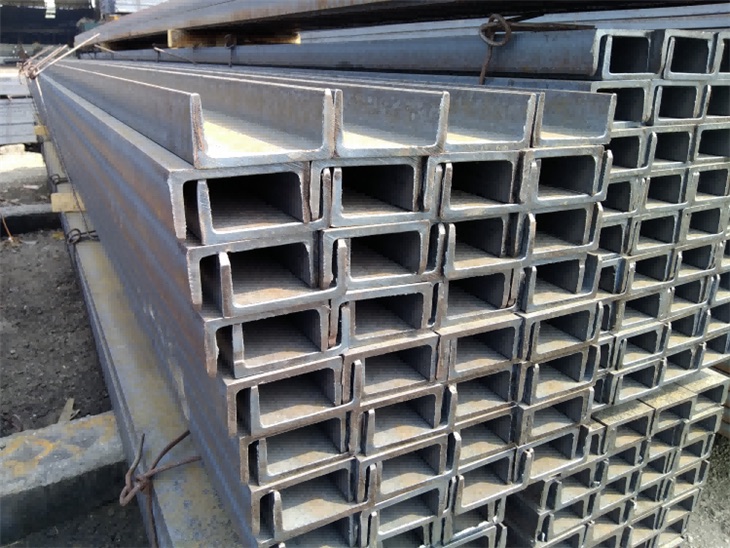
A steel channel has one web and two flanges, creating an open U-shaped cross-section. This geometry is useful in supporting frames, equipment bases, building facades, vehicle fabrication and structural assemblies. Channels can also form part of trusses and other engineered steelwork where access to the open side is useful for connections and installation.
Hot-rolled channels are formed by passing heated steel through shaped rolls. Pressed channels are made by bending sheet or plate to the required profile. The two routes produce different corner radii, wall thicknesses and section properties; a pressed channel should therefore be described by its drawing rather than substituted solely by nominal depth.
Specify the channel family or drawing, depth, flange width, web and flange thicknesses, and cut length. State whether tapered or parallel flanges are needed and whether the product will be welded, drilled or protected with a coating. The reference chemistry applies to carbon structural steel, not to stainless-steel or aluminium channels.
Size guide
Sizes & dimensions
Steel channels — Size guide
Parameter
Size or format
Reference rolled-channel depth
50–400 mm
Pressed-channel length described
6 m
Section dimensions
Depth × flange width × web / flange thickness
The 50–400 mm range is a reference for rolled channels; the 6 m length describes the pressed-sheet route. Confirm dimensions for the selected product form.
Technical reference
Analysis
Chemical composition is selected for the intended manufacturing or construction use. Confirm the agreed grade and heat analysis for the order.
Reading the values
≤ Maximum · ≥ Minimum
A dash between two values indicates a range.
Composition profile
Structural steel — chemical analysis
Reference ladle-analysis maxima, mass percentages, for structural sections of nominal thickness up to 40 mm.
Structural steel — chemical analysis
Parameter
Reference value
Unit
Carbon (C)
≤ 0.17
%
Manganese (Mn)
≤ 1.40
%
Phosphorus (P)
≤ 0.040
%
Sulfur (S)
≤ 0.040
%
Nitrogen (N)
≤ 0.012
%
Copper (Cu)
≤ 0.55
%
Carbon equivalent (CEV)
≤ 0.35
%
These tables describe reference composition options. Final chemistry and delivery requirements are confirmed in the quotation and heat-analysis certificate.
02 / Specification guide
Define your requirement.
These are the details to provide, not a fixed offered specification.
Application
Intended use, processing route and required delivery condition.
Chemical composition
Required element ranges and impurity limits.
Dimensions & tolerances
Required dimensions, length or particle sizing and permitted tolerances.
Quality requirements
Relevant mechanical or physical properties and inspection requirements.
Packing & identification
Packing format, bundle or lot identification and handling requirements.
Commercial terms
Quantity, delivery destination and required delivery window.
03 / Documents to request
Make the brief complete.
State which documents and approvals are required. Availability and scope are confirmed for each enquiry.
01
Batch or heat certificate of analysis for the agreed material.
02
Dimensional and relevant physical or mechanical inspection reports.
03
Packing list, lot identification and agreed shipment documents.