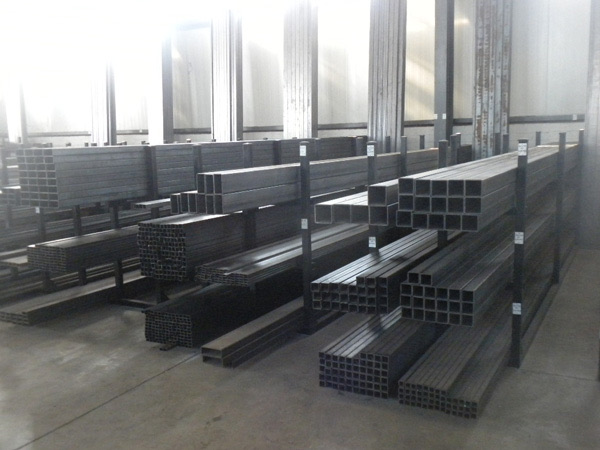
Column hollow sections are closed steel profiles commonly used where a compact square section is useful for structural framing. They are formed from steel sheet or strip and welded along a longitudinal seam. The closed shape provides stiffness in both principal directions, while the flat faces simplify many connection and fabrication details.
They are used in building columns, workshop frames, sheds, warehouses and other fabricated structures. The published column example is a 400 × 400 mm square section in a 12 m length. Its wall thickness must be specified because sections with the same outside dimensions can differ substantially in weight, stiffness and load capacity.
For a quotation, identify outside width and depth, wall thickness, length and the selected steel grade, together with any coating or end preparation. The reference chemistry illustrates a low-carbon option; it does not assign that grade or a wall thickness automatically to the 400 mm product.
Size guide
Sizes & dimensions
Column Hollow Sections — Size guide
Parameter
Size or format
Published square section
400 × 400 mm
Published length
12 m
Wall thickness
Specify for the structural design and required weight
Section designation
Width × depth × wall thickness × length
400 × 400 mm and 12 m describe the published column example. Confirm wall thickness and grade separately; they are not fixed by the outside dimensions.
Technical reference
Analysis
A low-carbon hollow-section analysis is shown as a material reference. Final chemistry is tied to the selected order grade.
Reading the values
≤ Maximum · ≥ Minimum
A dash between two values indicates a range.
Composition profile
Hollow sections — chemical analysis
A published low-carbon hollow-section composition, percentage by mass. Silicon is a range; the other entries are maxima.
Hollow sections — chemical analysis
Parameter
Reference value
Unit
Carbon (C)
≤ 0.16
%
Silicon (Si)
0.15–0.25
%
Manganese (Mn)
≤ 1.60
%
Phosphorus (P)
≤ 0.020
%
Sulfur (S)
≤ 0.012
%
These tables describe reference composition options. Final chemistry and delivery requirements are confirmed in the quotation and heat-analysis certificate.
02 / Specification guide
Define your requirement.
These are the details to provide, not a fixed offered specification.
Application
Intended use, processing route and required delivery condition.
Chemical composition
Required element ranges and impurity limits.
Dimensions & tolerances
Required dimensions, length or particle sizing and permitted tolerances.
Quality requirements
Relevant mechanical or physical properties and inspection requirements.
Packing & identification
Packing format, bundle or lot identification and handling requirements.
Commercial terms
Quantity, delivery destination and required delivery window.
03 / Documents to request
Make the brief complete.
State which documents and approvals are required. Availability and scope are confirmed for each enquiry.
01
Batch or heat certificate of analysis for the agreed material.
02
Dimensional and relevant physical or mechanical inspection reports.
03
Packing list, lot identification and agreed shipment documents.