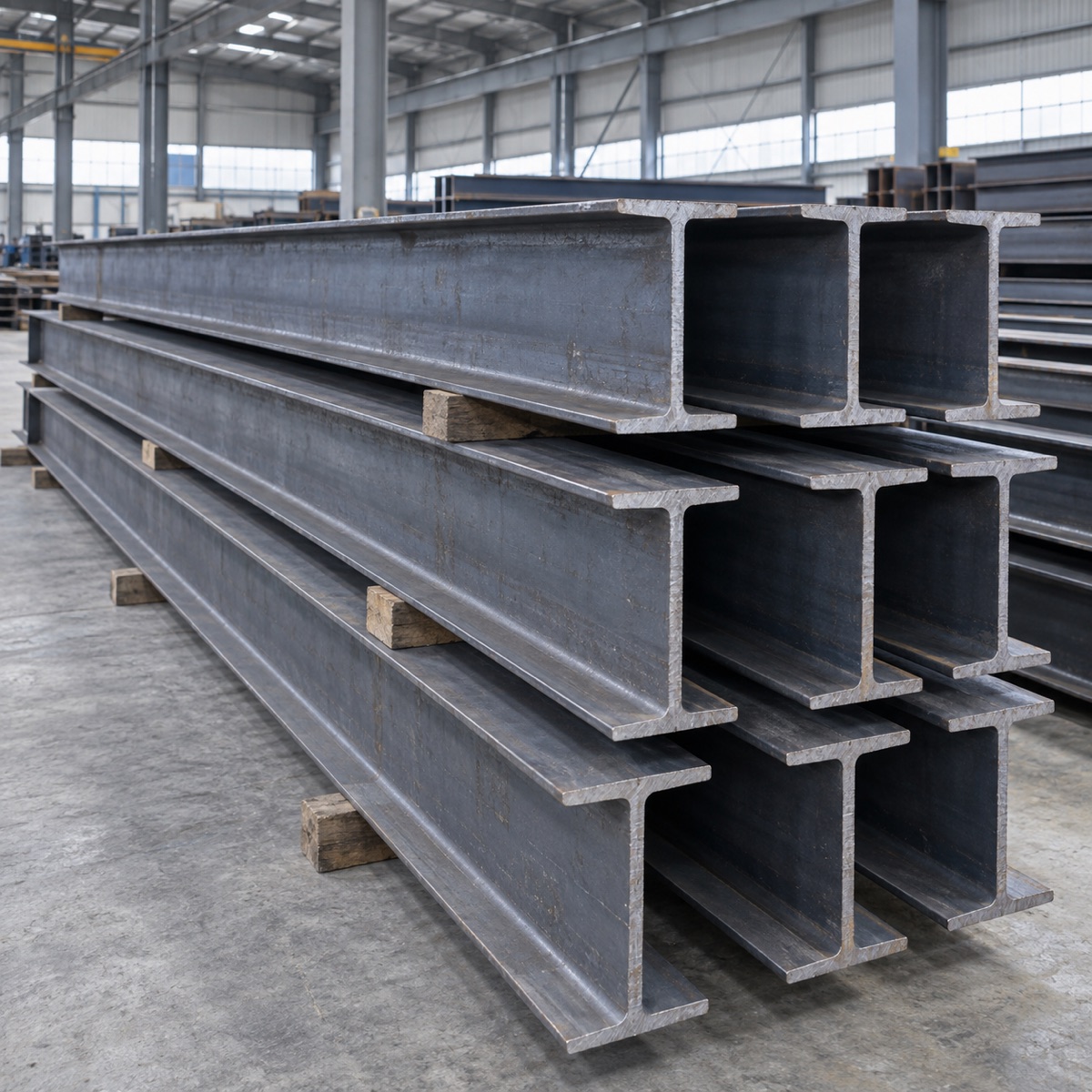
Structural steel beams are long load-bearing sections used in building frames and industrial steelwork. A beam has a web connecting two flanges, with the proportions of those elements determining its sectional properties. The catalogue includes I-shaped beams and wide-flange H-shaped members, each suited to different structural layouts and connection details.
Parallel-flange and tapered-flange I-beams should be distinguished when specifying a section. Wide-flange beams offer a different geometry, while fabricated or cellular beams require their own drawings and design checks. The choice cannot be made from nominal depth alone: flange width, web thickness, section mass and the steel grade also matter.
Provide the section designation or drawing, required length, quantity and grade in the enquiry. State whether the beams are intended for columns, floor beams, roof framing or another engineered use. The dimensional ranges are references for familiar beam families; exact geometry and suitability are confirmed for the selected section and project.
Size guide
Sizes & dimensions
Structural steel beams — Size guide
Parameter
Size or format
Parallel-flange I-beam series
IPE 80–750
Tapered-flange I-beam series
IPN 80–600
Ordering dimensions
Section designation, overall depth, flange width and length
The numbers identify nominal beam sizes in millimetres; exact depth and thickness depend on the selected section variant. These are reference series, not confirmed stock ranges.
Technical reference
Analysis
Chemical composition is selected for the intended manufacturing or construction use. Confirm the agreed grade and heat analysis for the order.
Reading the values
≤ Maximum · ≥ Minimum
A dash between two values indicates a range.
Composition profile
Structural steel — chemical analysis
Reference ladle-analysis maxima, mass percentages, for structural sections of nominal thickness up to 40 mm.
Structural steel — chemical analysis
Parameter
Reference value
Unit
Carbon (C)
≤ 0.17
%
Manganese (Mn)
≤ 1.40
%
Phosphorus (P)
≤ 0.040
%
Sulfur (S)
≤ 0.040
%
Nitrogen (N)
≤ 0.012
%
Copper (Cu)
≤ 0.55
%
Carbon equivalent (CEV)
≤ 0.35
%
These tables describe reference composition options. Final chemistry and delivery requirements are confirmed in the quotation and heat-analysis certificate.
02 / Specification guide
Define your requirement.
These are the details to provide, not a fixed offered specification.
Application
Intended use, processing route and required delivery condition.
Chemical composition
Required element ranges and impurity limits.
Dimensions & tolerances
Required dimensions, length or particle sizing and permitted tolerances.
Quality requirements
Relevant mechanical or physical properties and inspection requirements.
Packing & identification
Packing format, bundle or lot identification and handling requirements.
Commercial terms
Quantity, delivery destination and required delivery window.
03 / Documents to request
Make the brief complete.
State which documents and approvals are required. Availability and scope are confirmed for each enquiry.
01
Batch or heat certificate of analysis for the agreed material.
02
Dimensional and relevant physical or mechanical inspection reports.
03
Packing list, lot identification and agreed shipment documents.