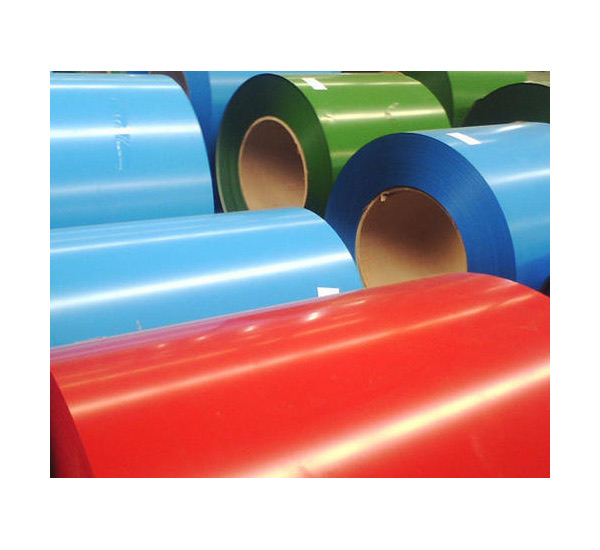
Colour-coated sheet is a layered product consisting of steel, a protective metallic coating and an applied paint system. It combines the shapeability of sheet steel with a finished colour surface. The exposed face and reverse face can have different coating thicknesses because they perform different roles in the final component.
Uses include roofing, wall cladding, suspended ceiling components, appliance panels, office equipment and industrial enclosures. Select the paint system for the intended indoor or outdoor exposure, expected forming operation and appearance. Colour alone does not define weathering resistance; coating type, gloss, zinc protection and the treatment of joints and cut edges also affect performance.
The coating dimensions below describe the published conventional front and back paint ranges. Base-steel thickness, width, cut length and colour are selected separately. The chemistry table describes one steel substrate option and does not describe the paint, zinc layer or finished coating system.
Size guide
Sizes & dimensions
Colour-Coated Sheet — Size guide
Parameter
Size or format
Front-face paint layer
20–25 µm
Reverse-face paint layer
7–15 µm
Base-steel dimensions
Specify steel thickness, coil width and cut length
Colour and surface
Confirm colour reference, gloss and paint system
Paint thickness is measured in micrometres and is separate from the steel thickness in millimetres. Other coating systems can have different paint-layer thicknesses.
Technical reference
Analysis
For a coated product, the following analysis applies only to the steel substrate. Confirm the paint and metallic coating requirements independently.
Reading the values
≤ Maximum · ≥ Minimum
A dash between two values indicates a range.
Composition profile
Forming sheet — base-steel analysis
Maximum ladle-analysis values of the steel substrate, percentage by mass. Zinc and paint layers are excluded.
Forming sheet — base-steel analysis
Parameter
Reference value
Unit
Carbon (C)
≤ 0.18
%
Silicon (Si)
≤ 0.50
%
Manganese (Mn)
≤ 1.20
%
Phosphorus (P)
≤ 0.12
%
Sulfur (S)
≤ 0.045
%
Titanium (Ti)
≤ 0.30
%
These tables describe reference composition options. Final chemistry and delivery requirements are confirmed in the quotation and heat-analysis certificate.
02 / Specification guide
Define your requirement.
These are the details to provide, not a fixed offered specification.
Application
Intended use, processing route and required delivery condition.
Chemical composition
Required element ranges and impurity limits.
Dimensions & tolerances
Required dimensions, length or particle sizing and permitted tolerances.
Quality requirements
Relevant mechanical or physical properties and inspection requirements.
Packing & identification
Packing format, bundle or lot identification and handling requirements.
Commercial terms
Quantity, delivery destination and required delivery window.
03 / Documents to request
Make the brief complete.
State which documents and approvals are required. Availability and scope are confirmed for each enquiry.
01
Batch or heat certificate of analysis for the agreed material.
02
Dimensional and relevant physical or mechanical inspection reports.
03
Packing list, lot identification and agreed shipment documents.