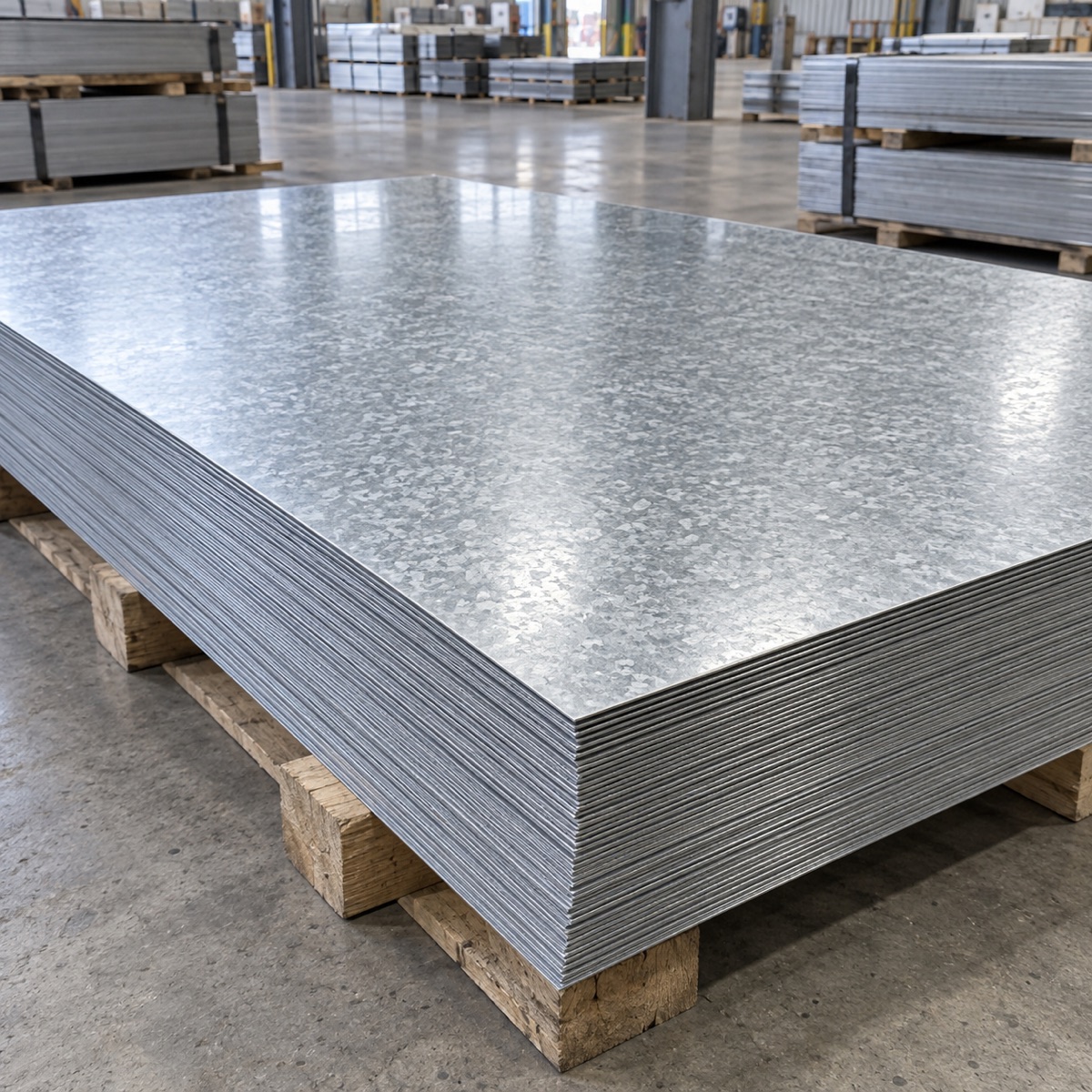
Galvanized sheet combines a steel substrate with a protective zinc coating. The steel supplies the mechanical properties, while the zinc helps protect the surface against corrosion. In continuous hot-dip production, prepared strip passes through molten zinc before cooling and finishing. The resulting sheet can be processed into components that require both formability and a protected surface.
Typical applications include roofing and cladding components, cabinets, ductwork, enclosures and fabricated industrial parts. Performance depends on the coating mass, exposure conditions, drainage and treatment of cut edges or welds. A galvanized surface does not by itself establish suitability for drinking-water contact or other specialised uses; those requirements are agreed for the finished application.
When enquiring, specify base-metal thickness, width, delivery length or coil format, zinc coating mass and the required appearance. The analysis below belongs to the underlying steel option, while the zinc coating is specified separately.
Size guide
Sizes & dimensions
Galvanized Sheet — Size guide
Parameter
Size or format
Reference forming-sheet thickness
0.45–3.00 mm
Reference width
Up to 1520 mm
Cut sheet length
2–6 m
Delivery form
Coil, slit coil or cut sheet
Thickness and width are a dimensional reference. The attainable combination depends on the coating and production route; confirm it with the required cut length.
Technical reference
Analysis
Compare separate forming-sheet and structural-sheet composition profiles. Both analyses refer to the steel beneath the zinc layer; coating mass is specified separately.
Reading the values
≤ Maximum · ≥ Minimum
A dash between two values indicates a range.
Composition profile
Forming sheet — base-steel analysis
Maximum ladle-analysis values of the steel substrate, percentage by mass. Zinc and paint layers are excluded.
Forming sheet — base-steel analysis
Parameter
Reference value
Unit
Carbon (C)
≤ 0.18
%
Silicon (Si)
≤ 0.50
%
Manganese (Mn)
≤ 1.20
%
Phosphorus (P)
≤ 0.12
%
Sulfur (S)
≤ 0.045
%
Titanium (Ti)
≤ 0.30
%
Composition profile
Structural sheet — base-steel analysis
Maximum ladle-analysis values of a structural coated-steel substrate, percentage by mass. The zinc coating is specified separately.
Structural sheet — base-steel analysis
Parameter
Reference value
Unit
Carbon (C)
≤ 0.20
%
Silicon (Si)
≤ 0.60
%
Manganese (Mn)
≤ 1.70
%
Phosphorus (P)
≤ 0.10
%
Sulfur (S)
≤ 0.045
%
These tables describe reference composition options. Final chemistry and delivery requirements are confirmed in the quotation and heat-analysis certificate.
02 / Specification guide
Define your requirement.
These are the details to provide, not a fixed offered specification.
Application
Intended use, processing route and required delivery condition.
Chemical composition
Required element ranges and impurity limits.
Dimensions & tolerances
Required dimensions, length or particle sizing and permitted tolerances.
Quality requirements
Relevant mechanical or physical properties and inspection requirements.
Packing & identification
Packing format, bundle or lot identification and handling requirements.
Commercial terms
Quantity, delivery destination and required delivery window.
03 / Documents to request
Make the brief complete.
State which documents and approvals are required. Availability and scope are confirmed for each enquiry.
01
Batch or heat certificate of analysis for the agreed material.
02
Dimensional and relevant physical or mechanical inspection reports.
03
Packing list, lot identification and agreed shipment documents.