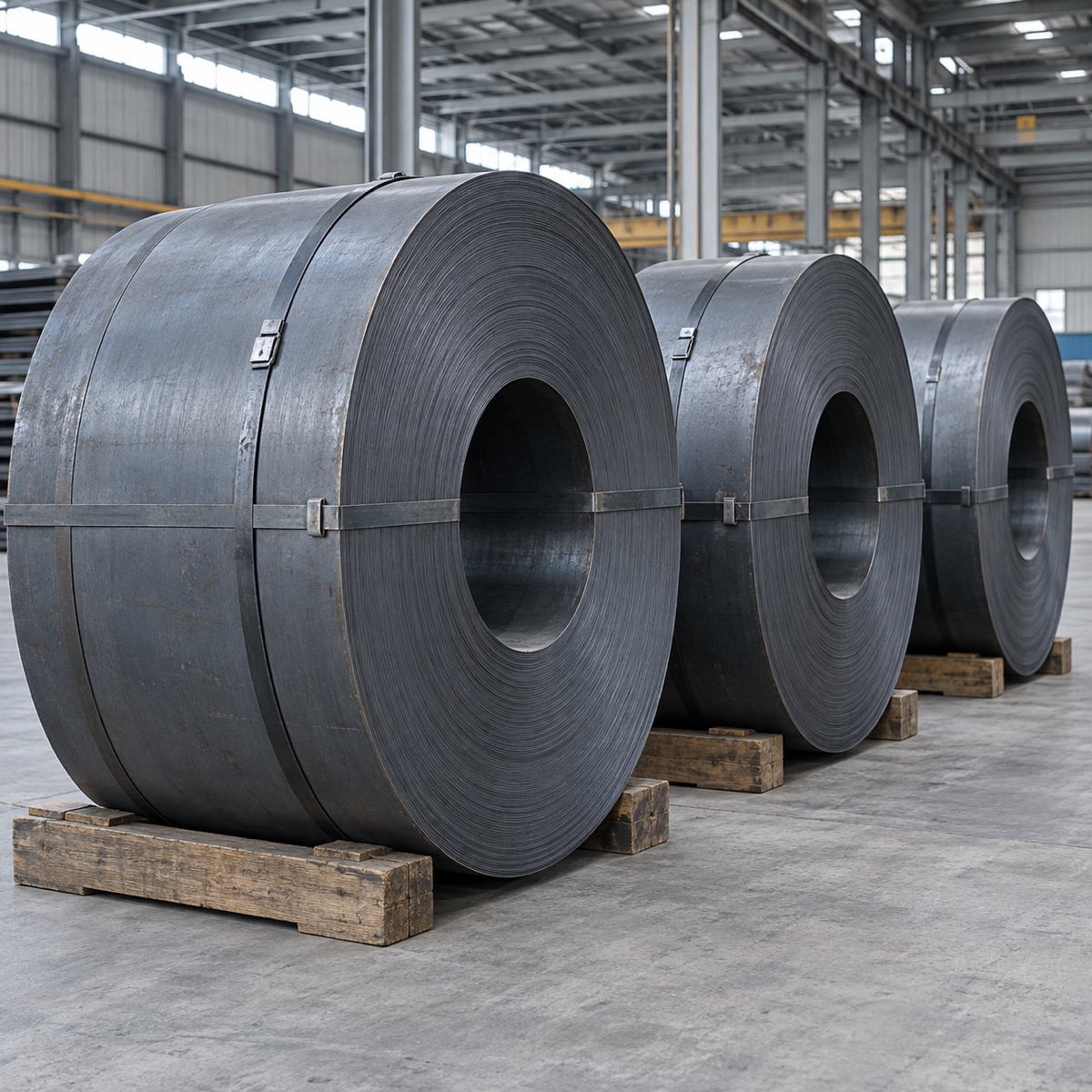
Hot-rolled sheet, commonly called black sheet, is produced by reducing heated steel through rolling stands. Cooling leaves a characteristic dark oxide scale on the surface. This is an uncoated flat-steel product; its appearance and finish differ from cold-rolled or zinc-coated sheet. It can be supplied in coil or cut into sheets for further processing.
Common uses include fabricated frames, equipment housings, vehicle components, welded tubes and formed profiles. Material selection depends on whether the part will be bent, welded, drawn or used to carry load. Surface scale may need removal before painting or a more demanding finishing operation. A structural sheet grade should not be assumed suitable for a pressure vessel or another specialised service.
An enquiry should identify the grade, thickness, width, sheet length or coil weight and whether the surface is supplied as rolled or pickled and oiled. The dimensional examples below are for discussing common flat-steel requirements, with the final size and finish confirmed for each order.
Size guide
Sizes & dimensions
Hot-Rolled Sheet — Size guide
Parameter
Size or format
Reference sheet example
2 mm × 1250 mm width
Reference sheet example
3 mm × 1500 mm width
Length / coil weight
Specify the cut length or required coil weight
These are reference size combinations within a published flat-steel range, not a stock list. Other sizes and heavier plate require a separate enquiry.
Technical reference
Analysis
Structural carbon steel is a common reference option for general structural sheet. The following values apply to that base-steel option, not to every hot-rolled grade.
Reading the values
≤ Maximum · ≥ Minimum
A dash between two values indicates a range.
Composition profile
Hot-rolled structural steel
Selected heat-analysis maxima for hot-rolled flat steel; percentage by mass. These values describe the feed sheet when it is formed into a profile.
Hot-rolled structural steel
Parameter
Reference value
Unit
Carbon (C)
≤ 0.17
%
Manganese (Mn)
≤ 1.40
%
Phosphorus (P)
≤ 0.035
%
Sulfur (S)
≤ 0.035
%
Copper (Cu)
≤ 0.55
%
These tables describe reference composition options. Final chemistry and delivery requirements are confirmed in the quotation and heat-analysis certificate.
02 / Specification guide
Define your requirement.
These are the details to provide, not a fixed offered specification.
Application
Intended use, processing route and required delivery condition.
Chemical composition
Required element ranges and impurity limits.
Dimensions & tolerances
Required dimensions, length or particle sizing and permitted tolerances.
Quality requirements
Relevant mechanical or physical properties and inspection requirements.
Packing & identification
Packing format, bundle or lot identification and handling requirements.
Commercial terms
Quantity, delivery destination and required delivery window.
03 / Documents to request
Make the brief complete.
State which documents and approvals are required. Availability and scope are confirmed for each enquiry.
01
Batch or heat certificate of analysis for the agreed material.
02
Dimensional and relevant physical or mechanical inspection reports.
03
Packing list, lot identification and agreed shipment documents.