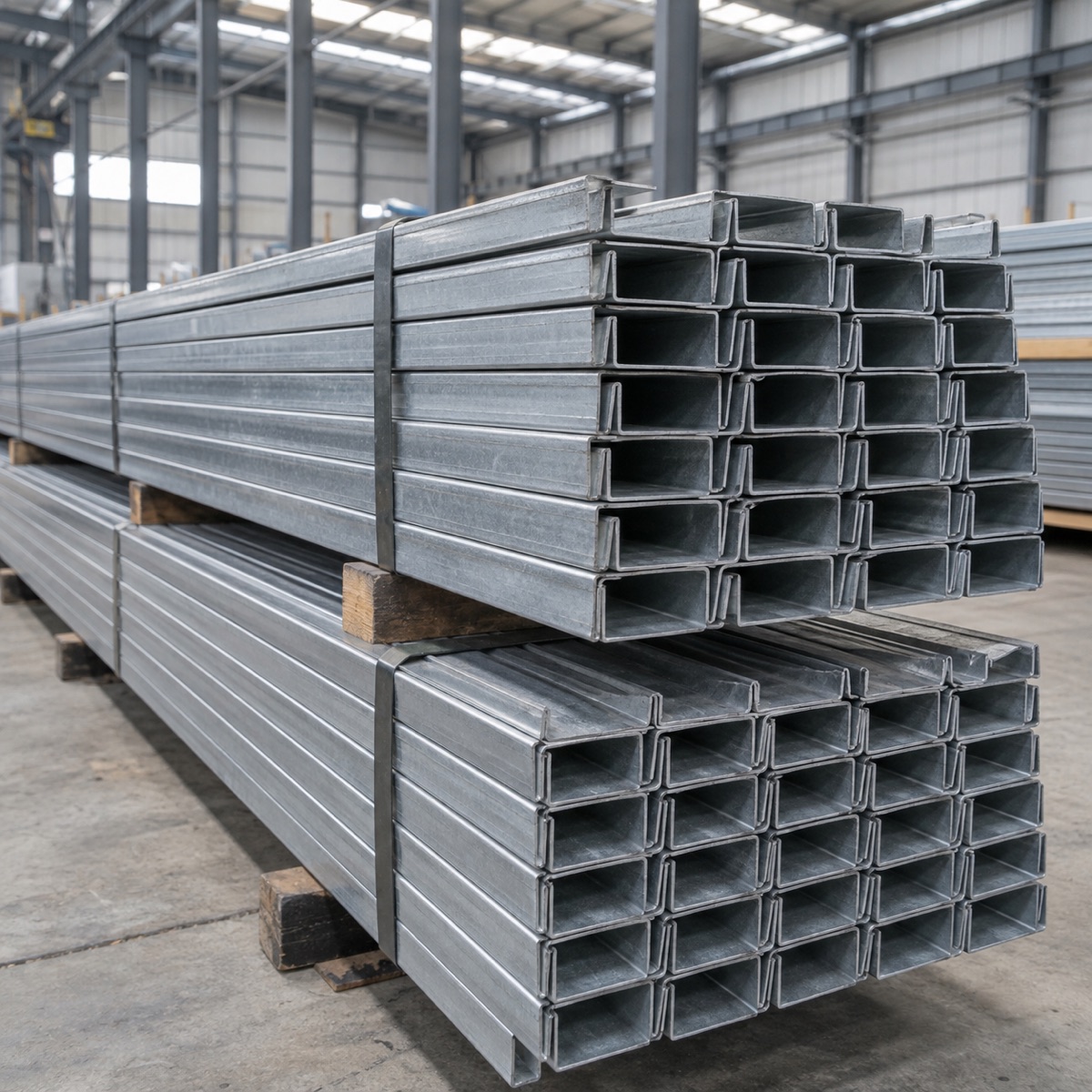
Open steel profiles have a cross-section whose edges do not join to form a closed tube. The family includes Z profiles, gutter sections and shaped frame profiles. Their geometry allows the designer to position flanges, lips and openings where they are needed for support, drainage or attachment to other components.
These profiles are used in building envelopes, light frames, roof details and fabricated assemblies. Their relatively accessible edges can simplify cutting, drilling and joining. The required stiffness and resistance to twisting depend on the complete cross-section, so an open profile should be selected from a drawing rather than from sheet thickness alone. Surface coating must match the exposure and the work carried out after forming.
Send web depth, flange widths, lip dimensions, bend radii, thickness and cut length with the enquiry. The Z-profile examples below are one included family; gutters and frame shapes require their own dimensions. Chemistry follows the chosen feed sheet, with a hot-rolled structural option shown for reference.
Size guide
Sizes & dimensions
Open Steel Profiles — Size guide
Parameter
Size or format
Included Z-profile examples
Z16 / Z18 / Z20 / Z22
Z-profile sheet thickness
2 / 2.5 / 3 mm
Gutters and frame profiles
Width, depth, lips and radius to drawing
Length
Cut length to the fabrication requirement
The numeric sizes above apply to the Z-profile family only. No single size range covers every gutter or open frame profile.
Technical reference
Analysis
Open-section chemistry depends on its feed sheet. The following hot-rolled example applies only when that material is selected.
Reading the values
≤ Maximum · ≥ Minimum
A dash between two values indicates a range.
Composition profile
Hot-rolled structural steel
Selected heat-analysis maxima for hot-rolled flat steel; percentage by mass. These values describe the feed sheet when it is formed into a profile.
Hot-rolled structural steel
Parameter
Reference value
Unit
Carbon (C)
≤ 0.17
%
Manganese (Mn)
≤ 1.40
%
Phosphorus (P)
≤ 0.035
%
Sulfur (S)
≤ 0.035
%
Copper (Cu)
≤ 0.55
%
These tables describe reference composition options. Final chemistry and delivery requirements are confirmed in the quotation and heat-analysis certificate.
02 / Specification guide
Define your requirement.
These are the details to provide, not a fixed offered specification.
Application
Intended use, processing route and required delivery condition.
Chemical composition
Required element ranges and impurity limits.
Dimensions & tolerances
Required dimensions, length or particle sizing and permitted tolerances.
Quality requirements
Relevant mechanical or physical properties and inspection requirements.
Packing & identification
Packing format, bundle or lot identification and handling requirements.
Commercial terms
Quantity, delivery destination and required delivery window.
03 / Documents to request
Make the brief complete.
State which documents and approvals are required. Availability and scope are confirmed for each enquiry.
01
Batch or heat certificate of analysis for the agreed material.
02
Dimensional and relevant physical or mechanical inspection reports.
03
Packing list, lot identification and agreed shipment documents.