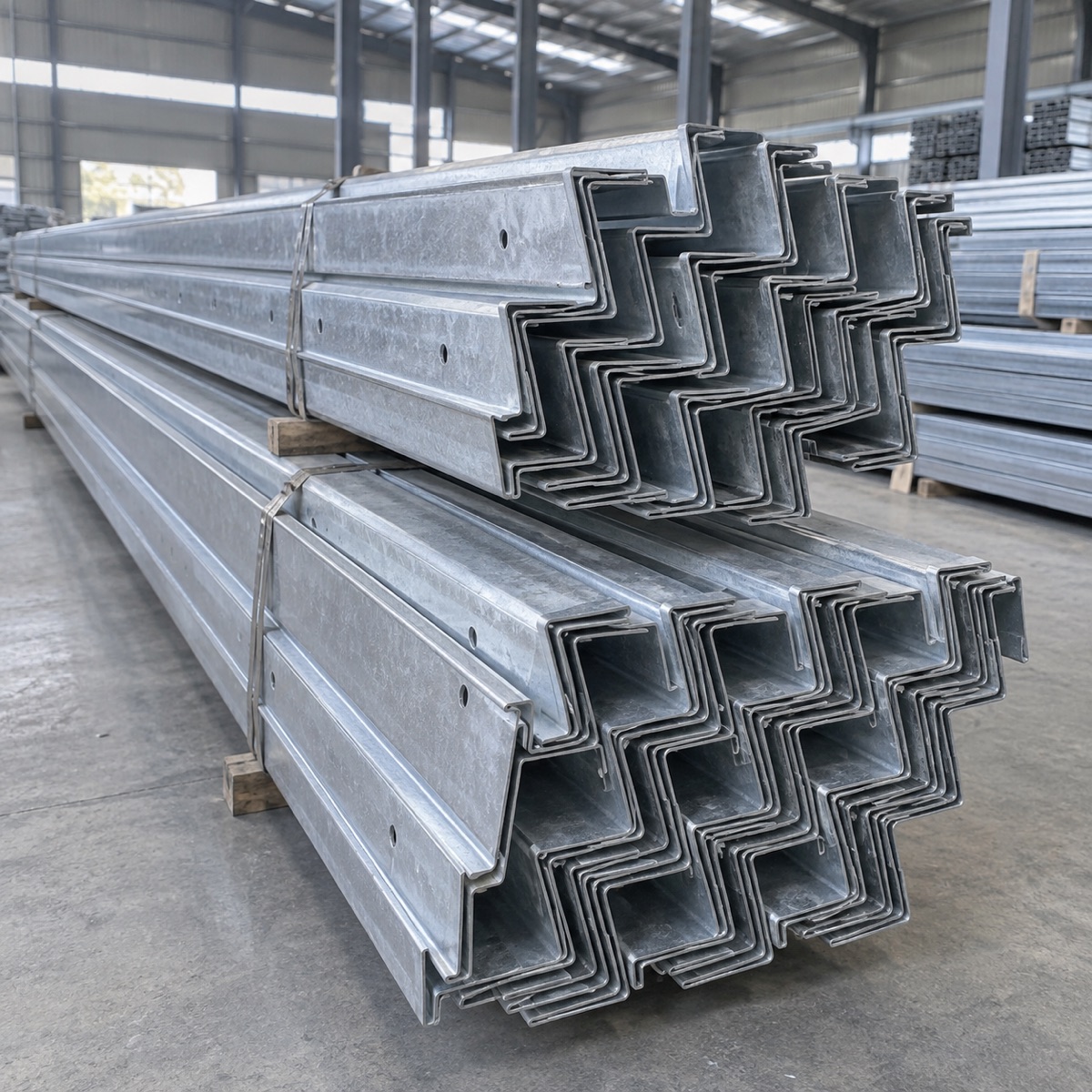
Z purlins are open steel sections with flanges on opposite sides of the web, forming a Z-shaped cross-section. They are made by forming strip or sheet into the required profile. The shape is widely used as secondary steelwork supporting roof sheets and transferring loads to the main frames of sheds, warehouses and industrial halls.
The product range includes nominal Z16, Z18, Z20 and Z22 sizes with sheet thicknesses of 2, 2.5 and 3 mm. A purlin's behaviour also depends on flange widths, return lips, span, restraints and connection details. Pre-punched holes can simplify site assembly, but the hole pattern must match the structural drawings rather than being selected from the section depth alone.
An enquiry should include the full section drawing, steel grade, thickness, length, quantity and surface protection. The reference chemistry below is for a hot-rolled feed sheet; coated or higher-strength purlin material can have a different composition and must be identified separately.
Size guide
Sizes & dimensions
Z Purlins — Size guide
Parameter
Size or format
Nominal section sizes
Z16 / Z18 / Z20 / Z22
Sheet thickness
2 / 2.5 / 3 mm
Flanges, lips and holes
To the section and connection drawing
Cut length
Specify for the building layout
Confirm the overall depth in millimetres and complete profile drawing for each nominal Z size. Thickness and nominal depth alone do not define the section capacity.
Technical reference
Analysis
This is a reference composition for purlins formed from hot-rolled sheet. The grade of the actual feed strip must be agreed for the project.
Reading the values
≤ Maximum · ≥ Minimum
A dash between two values indicates a range.
Composition profile
Hot-rolled structural steel
Selected heat-analysis maxima for hot-rolled flat steel; percentage by mass. These values describe the feed sheet when it is formed into a profile.
Hot-rolled structural steel
Parameter
Reference value
Unit
Carbon (C)
≤ 0.17
%
Manganese (Mn)
≤ 1.40
%
Phosphorus (P)
≤ 0.035
%
Sulfur (S)
≤ 0.035
%
Copper (Cu)
≤ 0.55
%
These tables describe reference composition options. Final chemistry and delivery requirements are confirmed in the quotation and heat-analysis certificate.
02 / Specification guide
Define your requirement.
These are the details to provide, not a fixed offered specification.
Application
Intended use, processing route and required delivery condition.
Chemical composition
Required element ranges and impurity limits.
Dimensions & tolerances
Required dimensions, length or particle sizing and permitted tolerances.
Quality requirements
Relevant mechanical or physical properties and inspection requirements.
Packing & identification
Packing format, bundle or lot identification and handling requirements.
Commercial terms
Quantity, delivery destination and required delivery window.
03 / Documents to request
Make the brief complete.
State which documents and approvals are required. Availability and scope are confirmed for each enquiry.
01
Batch or heat certificate of analysis for the agreed material.
02
Dimensional and relevant physical or mechanical inspection reports.
03
Packing list, lot identification and agreed shipment documents.