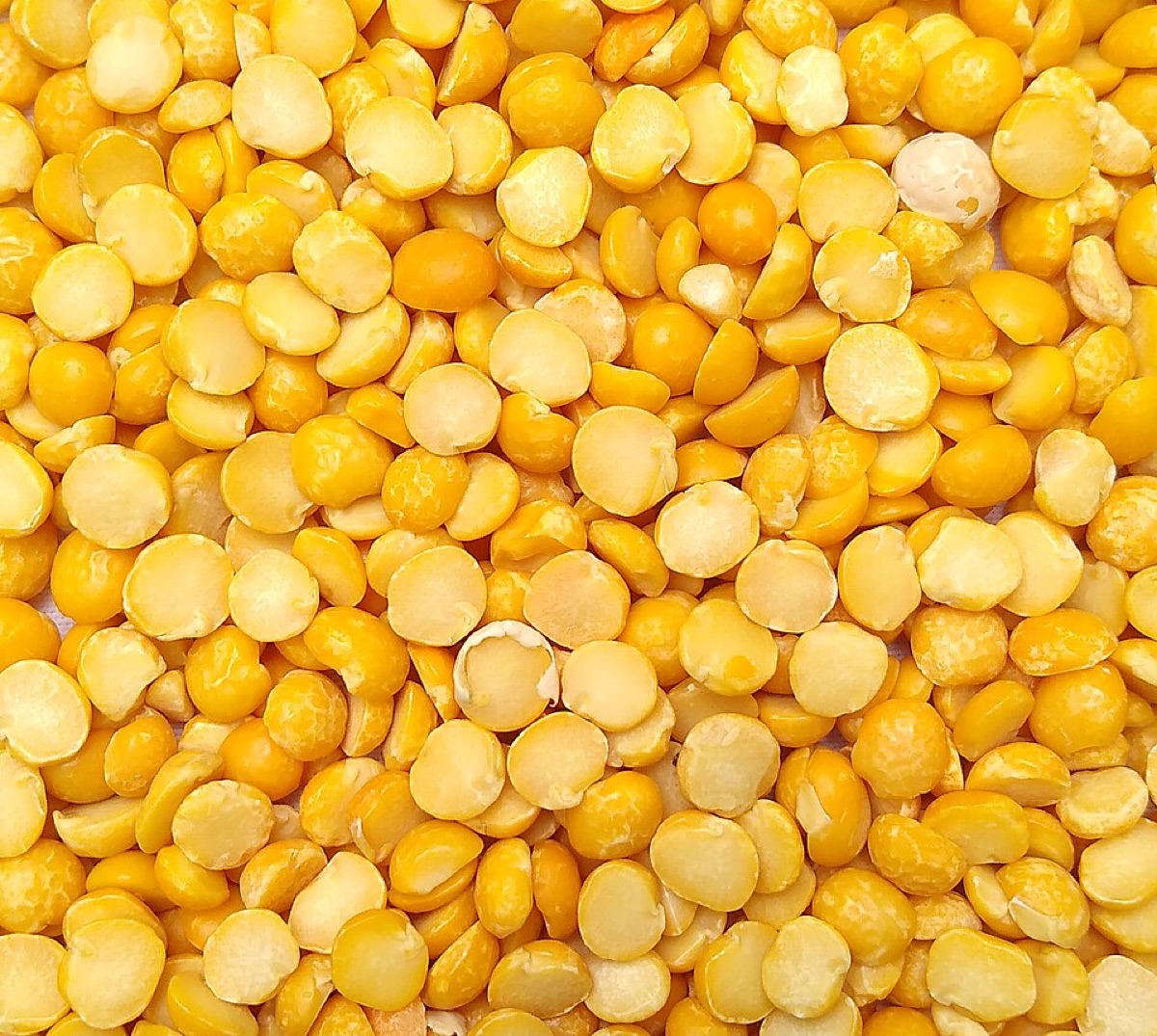
Split peas are dried peas that have been dehulled and separated into halves. They are sold in yellow and green forms and are valued for the texture they bring to soups and other cooked dishes. Removing the outer skin changes both their appearance and their behaviour in the pot, making them distinct from whole dried peas and from other split pulses.
Colour, form and identity
A well-defined split-pea product has a consistent colour and split size, with limited residual hulls, powder and small fragments. Yellow colour alone does not identify the species: the market name lappeh can also describe other split pulses. The actual pea identity matters because different pulses can give different flavours, textures and cooking results, even when their dry appearance is similar.
Food uses
Split peas are used in thick soups, stews, purees and pulse-based side dishes. As they soften, they can give a soup body and a smooth consistency. A stew intended to retain distinct pieces calls for a different cooking result from a fully blended preparation. Colour and the degree of softening both contribute to the appearance of the finished dish.
Packing and storage
Packaging should keep the product enclosed and protect the split peas from moisture, contamination and rough handling. Closed food-grade bags are commonly used for distribution. Store them in a dry, clean place away from strong odours and chemicals, with pest protection and space for inspection. Clear species and lot labels help prevent confusion with similar-looking split chickpeas or other pulses.
Common product questions
Does the name lappeh always mean split peas?
No. The market term can also be used for other split pulses. Confirm the actual species because similar yellow products may differ in flavour and texture and may perform differently in the same dish.
Can whole dried peas replace split peas directly?
Whole and split peas have different forms and cooking behaviour. Removing the hull and separating the seed changes the result, so a recipe designed for split peas may need adjustment if whole peas are used.
Why is the proportion of fines important?
Powder and small fragments can affect handling and the texture of the finished dish. A product with uniform halves gives a more consistent presentation, while excess fines may make it harder to obtain distinct pieces.
Technical reference
Reference analysis
The table provides reference quality criteria for the named pulse prepared for direct human consumption. The applicable moisture ceiling depends on climate, storage duration and whether the seed coat has been removed.
Reading the values
≤ Maximum · ≥ Minimum
A dash between two values indicates a range.
Reference analysis
Dehulled split peas — reference quality limits
Pisum sativum
Dehulled split product. Both moisture options are shown; choose the applicable option rather than treating the higher figure as suitable for every shipment.
Moisture — tropical climate or long storageLong storage: more than one crop year.
≤ 13
% m/m
Moisture — moderate climate or short storage
≤ 16
% m/m
Total extraneous matter
≤ 1.00
% m/m
Mineral matterIncluded in total extraneous matter.
≤ 0.25
% m/m
Impurities of animal originIncluded in total extraneous matter.
≤ 0.10
% m/m
These are published reference values for the named grade or product. The agreed order specification and the mill or batch certificate of analysis determine the supplied material.
02 / Specification guide
Define your requirement.
These are the details to provide, not a fixed offered specification.
Species & colour
Confirm pea species and yellow or green colour; name any alternative pulse explicitly.
Dehulling & split form
Dehulled halves, residual hulls and permitted whole seeds.
Fines & cleanliness
Limits for small fragments, powder, discolouration and foreign matter.
Moisture & cooking behaviour
Moisture limit and agreed softening or shape-retention expectations.
Origin & crop year
Country of origin, harvest year and lot identity; agree a representative sample.
Packing & delivery
Food-grade bag format, net weight, total quantity, destination and delivery window.
03 / Documents to request
Make the brief complete.
State which documents and approvals are required. Availability and scope are confirmed for each enquiry.
01
Lot-linked inspection report covering agreed moisture, size and defect limits.
02
Origin, crop year, packing list and batch traceability records.
03
Phytosanitary and other destination documents where required.
04
Agreed pesticide-residue and contaminant test reports, where applicable.